San Marcos Springs
Estimated read time: 20 minutes.
Estimated length: about 2,700 words.
This lecture is written for a community classroom.
Pre-session questions for attendees
-
What made San Marcos Springs more than just a water source, and how did its role change across different periods of Central Texas history?
-
What kinds of evidence allow archaeologists to say that this place was occupied across many periods of Central Texas history?
Lecture title
Where the Water Never Left: San Marcos Springs and 13,000 Years of Human Presence in Central Texas
Lecture script
Imagine standing at Spring Lake before there was a lake.
No glass-bottom boats. No university. No Aquarena. No mill dam. No San Marcos as a town. No Texas. No Spanish missions. No maps with county lines.
Instead, picture a limestone escarpment. Clear water pushes upward from the Edwards Aquifer. Some accounts and reconstructions describe springs that once rose visibly and forcefully from the earth. The water is steady. The temperature is steady. Around it are plants, fish, turtles, deer, birds, nuts, fruits, grasses, and stone suitable for toolmaking.
Now imagine that you are moving through Central Texas thousands of years ago. You know the landscape by memory, by story, by season, by kinship, and by risk. You know where water can fail. You know where animals gather. You know where good stone can be found. In a dry year, a reliable spring is not just scenery. It is a survival map.
That is the basic story of San Marcos Springs. It is not simply that people once lived here. It is that people kept coming here.
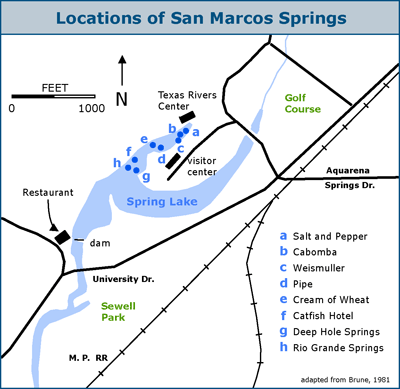
Archaeologists often use the phrase "persistent place" for locations that attract people repeatedly across long spans of time. Texas State University's Center for Archaeological Studies describes Spring Lake and San Marcos Springs in exactly that way: a place where geology, ecology, water, food, and human movement combined to draw people "over and over again" from the earliest known inhabitants of the Americas into the present. (springlakearchaeology.txst.edu)
The most attention-grabbing claim is this: the San Marcos Springs area may be among the oldest continually or repeatedly inhabited places in North America. The exact wording matters. "Continually inhabited" can sound like an unbroken town with permanent houses from 13,000 years ago to now. Archaeology rarely lets us say that with that kind of precision. What the evidence supports more securely is that the springs show an unusually long and repeated record of human presence across the cultural sequence of Central Texas. Texas State's archaeology project states that investigations at Spring Lake have revealed a seemingly continuous record beginning more than 13,000 years ago during Clovis times and continuing through the prehistoric sequence into Spanish Colonial and Historic periods. (springlakearchaeology.txst.edu)
Older summaries used a figure of about 11,500 years. David Nickels and C. Britt Bousman's archaeological testing report describes geological coring around San Marcos Springs and states that radiocarbon dates confirmed sediment accumulation spanning the last roughly 12,000 radiocarbon years. The same testing recovered lithic tools, faunal remains, burned rock features, floral remains, and cooking features from later periods. (scholarworks.sfasu.edu)
So the story begins with water, but it does not end there. The springs were powerful because they sat at a meeting point of habitats. Texas State's Spring Lake archaeology project describes the springs as lying at an ecotone, meaning a place where several ecological zones meet. That matters because different environments produce different resources. Around San Marcos Springs, people could find grasses, nuts, fruits, deer, fish, turtles, waterfowl, and sometimes bison. (springlakearchaeology.txst.edu)
This is one reason the site is such a strong teaching example. Archaeology is not just about objects. It is about relationships: people and water, people and animals, people and stone, people and memory, people and place.
The earliest part of the story belongs to the Paleoindian period. "Paleoindian" refers to the earliest widely recognized archaeological period of human occupation in North America. At Spring Lake, early evidence includes Clovis and Folsom projectile points recovered during underwater investigations led by Joel Shiner in the 1970s and 1980s. Clovis and Folsom projectile points are distinctive ancient stone spear points used by Paleoindian peoples in North America. These are important point types because they belong to some of the earliest archaeological traditions recognized across North America. Texas State's archaeology project notes, however, that these early specimens came from secondary deposits, meaning they were no longer in their original archaeological context. No intact Early Paleoindian deposits have yet been identified in controlled excavations at the site. (springlakearchaeology.txst.edu)
That point is worth pausing on. Archaeology is powerful not because every claim is simple, but because it is disciplined. A stone tool in the right layer, with a secure date and undisturbed context, tells a stronger story than a stone tool found loose or moved by water. Spring Lake is partly underwater today, and the modern lake itself was created by damming. Water preserved many materials, but water also moved some materials. So archaeologists have to ask: where was this object found, what layer was it in, what surrounded it, and could it have been displaced?
A 2022 study by H. L. Smith and colleagues specifically reevaluated fluted points from Spring Lake. The study notes that the site produced fluted points appearing diagnostic of Clovis technology, along with Ice Age animal remains, but also emphasizes that these materials appear to have been recovered from mixed lake deposits. (Taylor & Francis Online)
This does not make the site less interesting. It makes it more interesting. It means Spring Lake is both a place of deep antiquity and a place where evidence has to be handled carefully.
By the Archaic period, the story changes. The Archaic period in Central Texas lasted thousands of years. Texas State summarizes the Archaic stage as beginning around 8800 Before Present and continuing to roughly 1200 or 1300 Before Present, though archaeologists debate the exact boundaries. "Before Present" is an archaeological dating convention that counts years before 1950. (springlakearchaeology.txst.edu)
The Archaic period is not a single culture or a simple block of time. It is a long era of adaptation. People relied more heavily on local resources. They hunted deer and smaller game, used fish and turtles, processed plants, made ground stone tools, and cooked with heated stones. The Spring Lake archaeology project describes the Archaic as involving shifts away from Pleistocene megafauna toward smaller animals and plant foods, with increased use of ground stone, burned rock features, and woodworking tools. (springlakearchaeology.txst.edu)
Here the story becomes less about dramatic mammoth-hunting imagery and more about everyday intelligence. A burned rock feature may not look spectacular in a museum case, but it can tell us about cooking, repeated use of place, labor, diet, and social life. Nickels and Bousman's testing at San Marcos Springs documented intact burned rock features and concluded that these were constructed and used as cooking facilities by prehistoric inhabitants. Their report also identified animal remains including bison, antelope, deer, rabbits, turtle, fish, rodents, and snakes, along with evidence for plant use and firewood selection. (scholarworks.sfasu.edu)
That is a vivid image: not one dramatic event, but many meals. People cutting, scraping, cooking, repairing tools, returning to the same reliable water.
In the Middle Archaic, climate becomes especially important. Texas State's summary places the Middle Archaic in Central Texas roughly between 5750 and 4200 or 4100 Before Present and associates it with a period of fluctuating aridity and vegetation change. During drier episodes, aquifer-fed streams and resource-rich environments in Central Texas became especially important. (springlakearchaeology.txst.edu)
This is one of the central lessons of San Marcos Springs: stability is relative. Climate changed. Animals changed. Technologies changed. Social boundaries changed. But the springs remained unusually dependable. That dependable water made the place culturally durable.
The Late Archaic adds another layer. Texas State's summary describes the Central Texas Late Archaic as spanning roughly 4200 or 4100 to 1270 Before Present, with episodic bison returns, many projectile point styles, and evidence that population pressure and territoriality may have increased. (springlakearchaeology.txst.edu)
Again, the springs are not a backdrop. They are part of the social landscape. A reliable spring is a place of abundance, but abundance can draw many groups. A place that feeds people can also become a place of meeting, exchange, ceremony, contest, and memory.
Then, around the Late Prehistoric period, bow-and-arrow technology appears in Central Texas. Texas State notes that scholars have traditionally used the appearance of bow-and-arrow technology around 1200 Before Present as one marker for the end of the Archaic period, though some researchers argue for more continuity than rupture. (springlakearchaeology.txst.edu)
That detail matters because the public often imagines archaeological periods as clean chapters: first this people, then that people, then the next people. In reality, cultural change is often layered. A new weapon does not erase old knowledge. New social formations do not erase older attachments to water, stone, plants, animals, and sacred places.
For Indigenous communities connected to the region, the springs are not only archaeological. They are sacred and ancestral. Texas State's 2024 Hillviews article quotes Dr. Mario Garza of the Miakan/Garza Band of the Coahuiltecan Indians and the Indigenous Cultures Institute describing the springs as central to origin tradition and ceremony. The article also notes that descendants of Indigenous people from the region use the name "Sacred Springs" for the site. (hillviews.txst.edu)
This is where a community lecture should be careful. Archaeology can describe artifacts, sediments, dates, tools, animal bones, and features. Indigenous history includes those things, but it is not limited to them. A spring can be a resource, a campsite, a meeting place, a boundary marker, a sacred origin place, and a living presence all at once.
Then Europeans enter the story, and the timeline shifts again. Spanish explorers encountered San Marcos Springs in the 1690s, and Spanish accounts refer to Indigenous groups gathering at spring sites along the Balcones Escarpment. Texas State's recent account notes that the Spanish moved three missions to San Marcos in 1775, but those outposts lasted only a few years and no archaeological evidence of the mission structures has been found. (hillviews.txst.edu)
That is another useful teaching moment: absence of evidence is not the same as evidence of absence, but it does shape what archaeologists can responsibly say. Documents may say missions were moved. Archaeology has not yet located the structures securely. The historical record and the archaeological record talk to each other, but they do not always say the same thing at the same volume.
After the Texas Revolution, the Republic of Texas built Post San Marcos at the river's headwaters in 1840 to protect a road between San Antonio and Austin. A few years later, in 1845, Edward Burleson bought land including the springs, and around 1849 he built the first dam on the San Marcos River. That dam powered mills and helped create a commercial center, but it also submerged the springs under what became Spring Lake. (hillviews.txst.edu)
This is one of the most dramatic changes in the site's modern history. The springs that had once erupted visibly from the earth became hidden beneath lake water. The same act that supported settlement and commerce also transformed the landscape and covered ancient deposits.
The Texas State Historical Association entry by Joel Shiner notes that early Texans dammed the river below the springs, inundating ancient village areas under 10 to 12 feet of water. Shiner also emphasizes that the water helped preserve materials such as teeth, wood, and bones by protecting them under lake deposition. (tshaonline.org)
So the dam was destructive and preservative at the same time. It changed the springs, but it also helped seal parts of the archaeological record away from later disturbance. That paradox is part of what makes Spring Lake so compelling.
In the twentieth century, the site became associated with Aquarena Springs, a roadside and tourist attraction. Later, Texas State University acquired the property, and it is now associated with the Meadows Center for Water and the Environment. The modern glass-bottom boats are not just tourism. They are also a way of seeing layered history: spring vents, aquatic life, conservation, public education, and archaeology sharing the same water. (hillviews.txst.edu)
Now let us return to the opening question. Why here?
The answer is not one thing. It is water, but not only water. It is reliable flow from the Edwards Aquifer. It is the meeting of ecological zones. It is fish, turtles, deer, bison, plants, nuts, and waterfowl. It is chert for tools. It is a travel corridor. It is a gathering place. It is a sacred place. It is a place where later colonial roads, missions, military posts, mills, tourism, university research, and conservation all accumulated.
San Marcos Springs is not just old. It is layered.
For archaeologists, those layers include sediment cores, radiocarbon dates, stone tools, projectile points, animal remains, burned rock cooking features, plant remains, ceramics, beads, and historic materials. For Indigenous descendants, the springs also hold memory, ceremony, and origin. For the modern city, they are ecological infrastructure and civic identity. For the classroom, they are an unusually clear way to understand how place can outlast political borders.
If there is a single image to leave with, it is this: generation after generation, people came to the same water for different reasons. Some came following animals. Some came to gather plants. Some came to make tools. Some came to cook and camp. Some came to pray. Some came through Spanish colonial routes. Some came to build mills, roads, attractions, classrooms, and research centers.
The water kept surfacing.
That is why San Marcos Springs can carry such a long story. It is not a monument built by one ruler or one empire. It is a living spring system around which human life repeatedly organized itself.
And when we look at Spring Lake today, we are not looking at a park with a little history attached. We are looking at a place where geology, ecology, Indigenous history, colonial disruption, archaeology, tourism, and environmental protection all occupy the same ground.
Or, more precisely, the same water.
In summary
"When people say San Marcos is old, they do not mean old like a courthouse or a downtown square. They mean old like water routes, stone tools, cooking fires, origin stories, drought survival, and the repeated human decision to return to a place that kept giving life."
Core source list for the instructor
David L. Nickels and C. Britt Bousman, "Archaeological Testing at San Marcos Springs (41HY160) for the Texas Rivers Center, Hays County, Texas." Key evidence: cores, radiocarbon span, lithic tools, faunal remains, floral remains, burned rock cooking features. (scholarworks.sfasu.edu)
Texas State University Center for Archaeological Studies, "Exploring Spring Lake." Key concept: San Marcos Springs as a "persistent place." (springlakearchaeology.txst.edu)
Texas State University Center for Archaeological Studies, "The Paleoindian Period at Spring Lake." Key evidence and caution: Clovis and Folsom materials, secondary deposits, long sequence. (springlakearchaeology.txst.edu)
Texas State University Center for Archaeological Studies, "The Archaic Period at Spring Lake." Key context: Central Texas chronology, subsistence shifts, burned rock, climate, projectile point traditions. (springlakearchaeology.txst.edu)
Joel L. Shiner, "Spring Lake Site," Handbook of Texas Online. Key historical archaeology context: underwater investigations, damming, preservation, 12,000-year cultural sequence. (tshaonline.org)
H. L. Smith et al., "Evaluating the Fluted Points from Spring Lake, Texas." Key caution: Clovis-like fluted points and mixed lake deposits. (Taylor & Francis Online)
Overall The strongest evidence supports a very long, repeated and seemingly continuous human presence around San Marcos Springs. The phrase "oldest continually inhabited site in North America" is best presented as a prominent archaeological interpretation, not as a settled ranking.
Possible pre-lecture question answers
Question 1: "What made San Marcos Springs more than just a water source, and how did its role change across different periods of Central Texas history?"
Possible answers:
"The springs provided reliable water, but they also concentrated food, animals, plants, and other resources in one place."
"They sat at an ecological meeting point, so people could draw on multiple environments: river, prairie, woodland, and limestone uplands."
"The springs supported hunting, fishing, plant gathering, toolmaking, cooking, and repeated camps over thousands of years."
"The site became a persistent place because people kept returning to it across changing climates, technologies, and cultures."
"For Indigenous peoples, the springs were not only practical; they were also ancestral, sacred, and socially important."
"During Spanish colonial activity, the springs became part of travel routes, mission history, and colonial movement through Central Texas."
"In the 1800s, the springs became tied to settlement, military roads, damming, mills, and the growth of San Marcos as a town."
"In the 1900s and today, the springs became a site of tourism, research, conservation, and environmental education."
"The thing that stayed constant was dependable water; what changed was how different communities understood and used the place."
Question 2: "What kinds of evidence allow archaeologists to say that this place was occupied across many periods of Central Texas history?"
Possible answers:
"Stone tools and projectile points show human activity across different technological periods."
"Clovis and Folsom-style materials suggest very early Paleoindian presence, though some early finds came from mixed or secondary deposits."
"Burned rock features suggest cooking and repeated domestic activity."
"Animal bones, including deer, fish, turtles, rabbits, and bison, help reconstruct diet and local ecology."
"Plant remains and charcoal can show what people gathered, burned, cooked, or used as fuel."
"Sediment cores and radiocarbon dating help establish how long deposits have accumulated around the springs."
"Different projectile point styles help archaeologists connect artifacts to broad periods such as Paleoindian, Archaic, and Late Prehistoric."
"Underwater archaeology matters because the dammed lake covered parts of the ancient site, preserving some materials while also disturbing others."
"Historic records from Spanish and later Anglo-Texan periods add another layer of evidence, though documents and archaeology do not always line up neatly."
"The strongest argument comes from the combination of many evidence types, not from a single artifact."